Stroke rehabilitation is treatment through movement that helps you regain strength, balance and walking after a stroke. It should continue straight after you leave hospital, with exercise that is carefully dosed and increased gradually. Kaloyan Zarkov does stroke rehabilitation at the practice in Lozenets and at home, including with patients who are bedridden. He is a kinesitherapist, which means he treats with exercise and manual therapy, and has experience in neurology.
What to expect
At the first session Kaloyan asks about your stroke and how it progressed, and what you find difficult today. Bring the discharge summary from the hospital and your scans and test results. He checks how strong and how tight your muscles are, your balance, and how you sit, stand and walk. Then you set goals together: for example getting out of bed on your own, walking around the home without help, or holding a spoon again with the weaker hand.
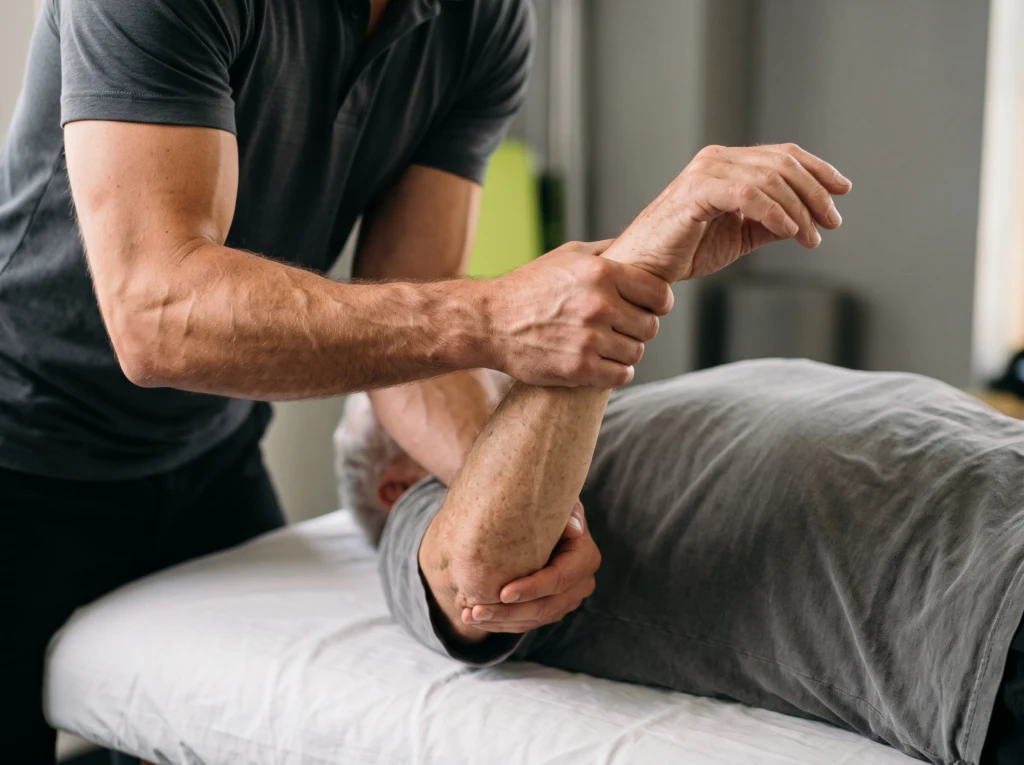
Kaloyan uses PNF (exercises in which he guides the movement with his hands), massage and active movements that you do yourself, if you can already move the arm or leg. The exercise is carefully dosed and increased gradually. Regular sessions are recommended, 4–5 times a week, depending on your condition.
At home visits Kaloyan works where you live: exercises in bed and on a chair, standing up and sitting down, walking with a frame or a stick, and balance exercises. He shows your family how to help with standing and walking and how to make the home safer. Once you get around more easily, you can continue at the practice in Lozenets, working in the exercise room. If you aren’t sure where to start, book a consultation.
Later, when time has passed and movement stops improving, Kaloyan may add electrical muscle stimulation (EMS). It “wakes up” the muscles and reduces spasm. The aim is for slight twitches to appear in the affected arm or leg, which you can then build on.
Recovery after a stroke is different for everyone. Rehabilitation usually goes on for months, with no fixed end date. Most change usually comes in the first months, but progress is possible later too, if the exercises continue. That is why you go home with a few exercises for every day, shown and explained to you and your family. A few days after the first session Kaloyan calls to ask how you are getting on and whether to change anything. A full recovery can’t be promised, but every step towards more independence matters.
What it helps with
- Weakness or stiffness on one side of the body, in the arm, the leg or both (hemiparesis)
- Muscles that tighten and pull the arm or leg into one position (spasticity)
- Poor balance, difficulty walking and a fear of falling
- Shoulder pain or a weak arm that “hangs”
- Difficulty with fine movements: fastening buttons, writing, picking up a cup
- Difficulty getting out of bed or up from a chair
Who it’s for
- You have recently left hospital and want rehabilitation to continue straight away.
- Someone close to you is bedridden or can’t yet come to the practice.
- You already get around more easily and want to continue in the exercise room for strength, balance and walking.
- Years have passed since the stroke, but you want to move more and with more confidence.
When it isn’t suitable
- You have signs of a new stroke: a sudden drooping face, weakness or numbness in the arm or leg, slurred speech. Call 112 straight away, even if the signs pass quickly.
- Your doctor has told you there is a risk of a blood clot. Then rehabilitation starts only after you have seen a cardiologist.
- You have open pressure sores (bedsores). They must be treated before therapy starts.
- Your calf is swollen, painful and warm, or you have chest pain and shortness of breath. This may be a blood clot (thrombosis), and you need to see a doctor urgently.
- Problems with speech and swallowing. Kaloyan doesn’t treat these; a speech and language therapist usually does.