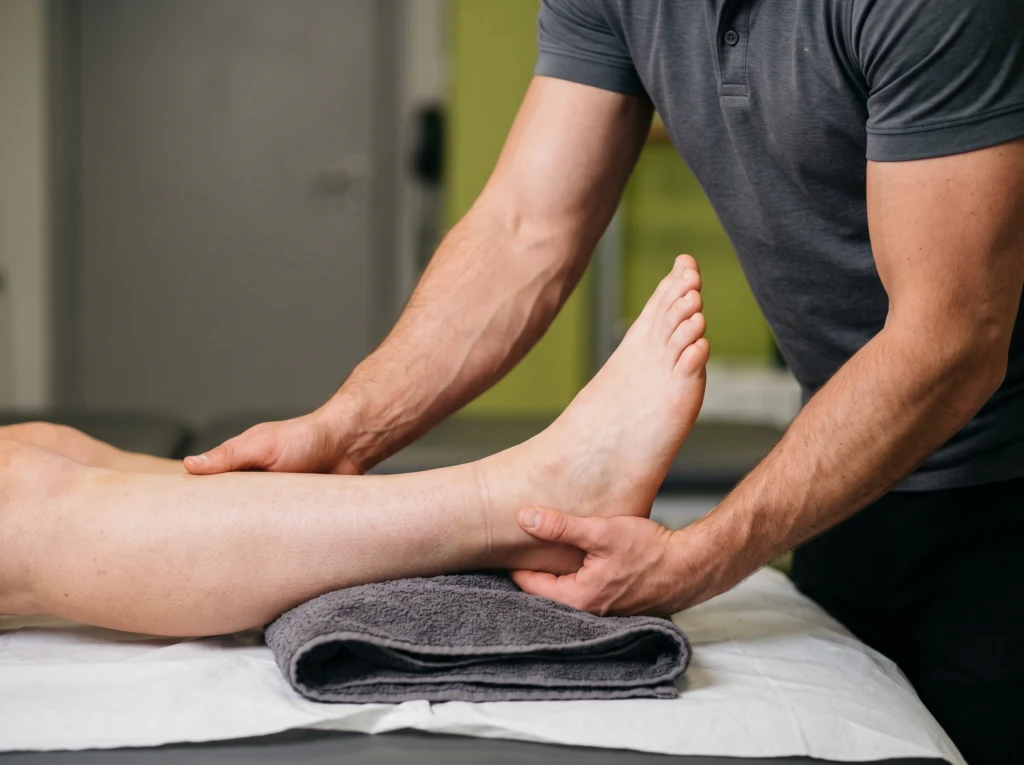
Rehabilitation after a fracture brings back movement and strength in the joint and muscles once the bone has healed in a cast or splint. Kinesitherapy for injuries is rehabilitation with exercise and manual therapy after an injury that wasn’t operated on: a fracture treated in a cast, a sprain, a dislocation, or a joint that has stiffened after long immobilisation. Kaloyan Zarkov does it at the practice in Lozenets and has experience in orthopaedics and traumatology. He most often works after fractures of the shoulder and upper arm (humerus), the ankle and the wrist. He loosens the stiff joint by hand, and uses exercises to rebuild strength, balance and the confidence to put load on it.
What to expect
The first session starts with a conversation: what happened, how it was treated and what you want to be able to do again. Bring your X-rays, the discharge summary and the orthopaedic doctor’s instructions, if you have them. Kaloyan asks what you are allowed to do: whether you can move the joint, whether you can put weight on the leg, and how much. Then he watches how you move and checks the range of movement, muscle strength, swelling and where it feels tight. The orthopaedic doctor’s timelines are always followed, and where needed Kaloyan gets in touch with the doctor.
Mobilisation after a cast starts straight after it comes off. Until then you move the neighbouring joints that aren’t in the cast, for example the fingers and elbow with a broken wrist. The orthopaedic doctor or Kaloyan explains what to do at home while you are in the cast. After that the work goes in stages. First comes manual therapy, meaning loosening the joint by hand, and device-based physiotherapy. Then come passive-active movements: you move the joint yourself and Kaloyan takes the movement further than you can on your own. Last are active exercises for muscle strength, balance and walking, in the exercise room with wall bars, resistance bands, weights and exercise balls.
With Combined physiotherapy Kaloyan chooses, from all the devices at the practice, the ones that suit you. When pain or stiffness gets in the way, he combines the work with TECAR therapy or ultrasound therapy, and for a badly weakened muscle with electrical muscle stimulation (EMS). For tight muscles, for example in a frozen shoulder, he may also use dry needling. The devices and dry needling are part of the session and are included in its price.
Kaloyan also works after a fracture of a vertebra that was not operated on. He first goes through your medical records, X-rays and the discs with your scans, then makes a programme to suit you. If the vertebra was operated on, choose post-operative rehabilitation. If you are older and getting around is hard, the trip to the practice can be a big effort. Then Kaloyan can come to you with home visits.
You may feel some pulling and pressure, but there shouldn’t be sharp pain. If anything is uncomfortable, say so. You go home with a few exercises, shown and explained. A few days after the first session Kaloyan calls to ask how you feel and whether to change anything. You usually need 5–10 sessions. Exactly how many depends on the injury and on how long the joint was immobilised. Wear comfortable clothes that leave the area easy to reach.
What it helps with
- A fracture of the shoulder and upper arm (humerus), the ankle or the wrist, treated in a cast or splint
- A stiff joint and weak muscles after the cast comes off, when the fracture wasn’t operated on
- A fracture of a vertebra without surgery, with a programme made after reviewing your scans and test results
- A sprained ankle, knee or wrist
- A dislocated joint (luxation), after a doctor has put it back in place
- A stiff shoulder, knee or ankle after an injury or long immobilisation
- Frozen shoulder (adhesive capsulitis)
- Pain and unsteadiness when you put weight on the leg after an injury, for example on stairs or uneven ground
Who it’s for
- Your cast has come off, but your arm or leg still doesn’t do what you want.
- Your joint is stiff and you can’t lift your arm or bend your leg all the way.
- You have sprained your ankle and want to get back to sport without another injury.
- Your shoulder has been stiffening for months and hurts when you lift your arm.
- You are older, find it hard to get around after a fracture and want rehabilitation to start at home.
When it isn’t suitable
- The fracture is recent and the orthopaedic doctor hasn’t yet allowed movement.
- The injury was operated on, for example with a plate, screws or a nail. Then choose post-operative rehabilitation, which follows the surgeon’s timelines.
- The pain started after a fall or a blow and you don’t have an X-ray yet.
- The joint is warm, red and swollen, or you have a temperature.
- The pain is getting worse instead of better, your fingers are going numb, or your calf is swollen, painful and warm. See a doctor first.