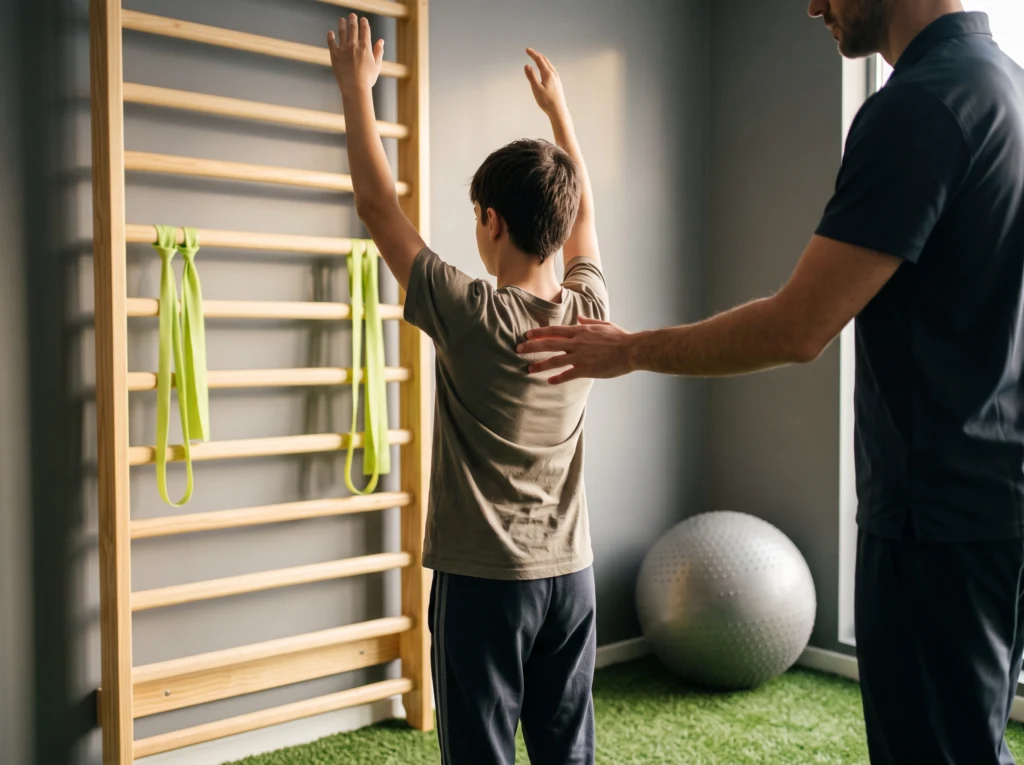
Corrective exercises are a programme of posture correction exercises for a curved spine and poor posture. They help with scoliosis (a sideways curve of the spine), a rounded upper back (kyphosis) and an overly arched lower back. They suit growing children and adults who sit all day. The aim is stronger back and abdominal muscles, better posture and less pain.
What to expect
At the first session Kaloyan looks at your posture from the front, side and back, and as you bend forward. He checks whether your shoulders and pelvis are level, how flexible your back and hips are, and how strong the muscles are that hold your body upright. If you have an X-ray or a report from an orthopaedic doctor, bring them.
The exercises are matched to the type of curve. They usually include strengthening the back muscles and the muscles between the shoulder blades, abdominal work, stretching the shortened muscles of the chest and thighs, and exercises for breathing and balance. In front of a mirror it is easier to feel what good posture looks like. With children, Kaloyan varies the exercises to keep them interesting.
Corrective exercises give results when you do them regularly. You usually come 1–2 times every 2 weeks, and between sessions you do exercises at home, 20–30 minutes a day. Changes in posture take months to show, not weeks.
What it helps with
- Poor posture: rounded shoulders, head forward, a “sagging” belly
- Mild to moderate scoliosis, alongside monitoring by an orthopaedic doctor
- Increased kyphosis (rounded upper back) in children and adults
- An overly arched lower back (hyperlordosis)
- Back and neck pain from sitting for long periods
- Uneven shoulders or shoulder blades that stick out
Who it’s for
- Your child has a rounded back, or an orthopaedic doctor has found a slight curve in the spine.
- You work at a computer all day and your neck and back hurt in the evening.
- You are a teenager, you have grown quickly and your muscles can’t yet hold a good posture.
- You want to carry on with the exercises you did after treatment for scoliosis.
When it isn’t suitable
- The curve is getting bigger quickly, or it is large. Then an orthopaedic doctor leads the treatment, for example with a brace, and the exercises are an addition to it.
- Your child has back pain that wakes them at night or doesn’t go away with rest. A doctor needs to see them first.
- There has been a recent injury to the spine.