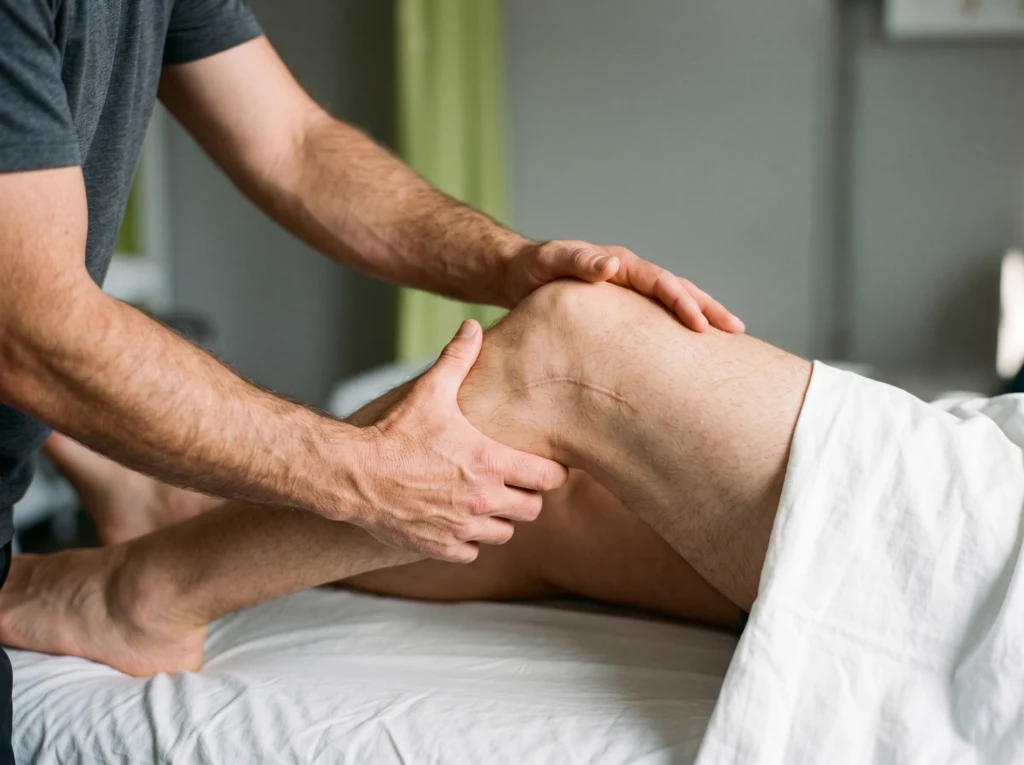
Rehabilitation after surgery helps you get back movement, strength and confidence in the joint that was operated on. The earlier it starts, the easier it is to regain your range of movement. Kaloyan Zarkov works with patients after knee and shoulder surgery, after joint replacement and after fractures. He has experience in orthopaedics and traumatology.
What to expect
At the first session, bring the discharge summary from the hospital and the instructions your surgeon gave you. Kaloyan asks how the operation went and what you are allowed to do. Then he looks at the swelling and the scar, measures how far the joint bends and straightens, and tests the strength of the muscles.
In the first weeks the work is gentle: movements within the range you are allowed, light mobilisation of the joint, work on the swelling and “waking up” the muscles that often don’t respond after surgery. After knee surgery this is most often the quadriceps, the muscle at the front of the thigh. Gradually we add exercises for strength, balance and walking. The exercise room has wall bars, resistance bands, weights and exercise balls, so the exercises mirror everyday life: getting up from a chair, climbing stairs, walking without crutches.
Kaloyan always keeps to your surgeon’s timelines. If a movement or load isn’t allowed yet, he leaves it out, and if he’s unsure, he checks with your doctor.
Some mild discomfort and tiredness after a session are normal. There shouldn’t be sharp pain, and if it appears, tell Kaloyan straight away. You leave with a few exercises to do at home, shown and explained, because the result also depends on what you do between sessions.
How long rehabilitation takes depends on the operation. It is usually 2–3 sessions a week for a few weeks. After a joint replacement or a cruciate ligament reconstruction, full recovery takes months.
What it helps with
- After anterior cruciate ligament (ACL) reconstruction or meniscus surgery
- After a hip or knee replacement
- After shoulder surgery, for example for a torn rotator cuff or an unstable shoulder
- After fractures treated with pins, plates or screws (internal fixation), for example of the ankle, wrist or thigh bone
- After arthroscopy (keyhole surgery) of the knee, shoulder or ankle
- After a torn Achilles tendon has been repaired
- After spinal surgery, once your doctor allows you to put load on the spine
Who it’s for
- You have just been discharged and don’t know which movements are safe.
- The joint is stiff and you can’t bend or straighten it fully.
- You are walking with crutches and want to walk normally again.
- It has been months since the operation, but your strength and confidence are still not what they were.
- You play sport and want to get back to training without risking a new injury.
When to call your doctor first
- The wound is red, warm, swollen or leaking fluid, or you have a fever.
- Your calf is suddenly swollen, painful and warm. This could be a blood clot (thrombosis) and needs to be seen urgently.
- The pain has got much worse after a fall or a sudden movement.
- If you aren’t sure what your surgeon has allowed, ask them before the first session or bring the written instructions.